

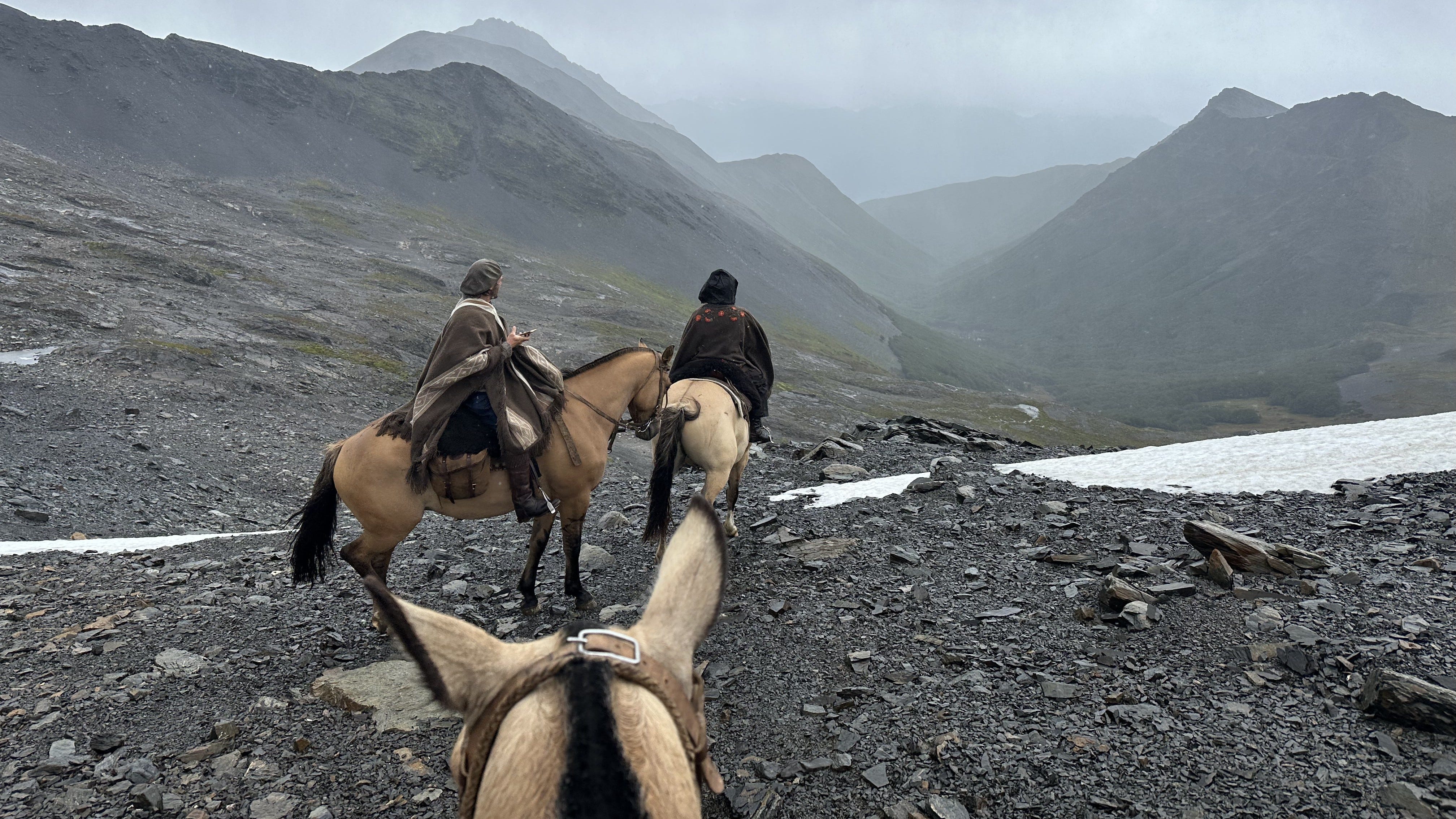
By the middle of our journey, the day’s routines were familiar. An easy gathering at the table for breakfast; saddlebags loaded; recado — the tack — well secured. But this morning’s departure marked the start of something new as well: a two-day trek south through the valley, then up into the mountains, with a night spent outdoors before we traveled on again, back to the estancia. We would carry with us what we would need throughout the day, while the support riders, Colo and Chucho, would pack in supplies for the night. This time, I knew where we were headed: as close to the end of the earth as this ride would take us.
We rode with the quiet efficiency that serves a long day in the saddle. The wind had picked up, high clouds scrimmed the sun, and the ponchos came out, along with the flasks for a warming nip of whiskey now and then. Strong-necked and heavily flanked, our short-legged horses were built for endurance, not speed, and their solid strength was both a comfort and a gift. All of us together moved through the valley with ease, having found a working rhythm — horses and humans keeping one pace.
Sometime that morning, an unexpected sound — from somewhere just behind our group — told us we were no longer alone. Behind us, we spied a lone guanaco, the wild ancestor of the domestic llama. As the sentinel male, he paced us through the grassland, laughing as we went. I was used to the sound of the guanaco by now, but his laugh ran lower and slower than the others we’d heard, with a guttural edge. “He’s making sure we leave,” I quipped, though not at all in jest. From the farther ridge, the larger herd watched; they left the warning to him.
As early morning gave way to early afternoon, Marcos pointed in the distance, where we could make out the contours of a simple hut that marked the spot of El República, an old grazing camp. We would stop there and rest, he said, to prepare for the climb. Relieved to find respite from the wind and chill, we made our way inside the low-ceilinged single room, fitted out with a wood-burning box stove in the corner. Nailed to the wall was a brass plaque, written in Spanish and dated 2012. The owners, it explained, “leave the door open for the free and careful use of whoever visits.”
And so we did. As Marcos and Jacinto tended to the horses and tack, the four of us guest riders settled in. Taking the sheepskins from our recado, we spread out on the floor and on the rough-sawn planks that served as impromptu bunks. Like restless kindergarteners, we giggled and joked a bit, protesting that we simply weren’t tired. And then, of course, we slept, wakening again only when Marcos peeked his head through the door. “Time for the mountain,” he said.
So, we mounted again and set out once more. As the afternoon deepened, the ground began to rise, and the open valley gave way to beech forest — lenga and coihue draped in lichen. The trees held to the sloping ridge’s western wall as the valley narrowed toward rain-hazed mountains, still in the distance.
Then, the lenga thinned as we climbed, the trees growing low and wind-bent before they gave out altogether, and the last of the green fell behind us. Above the tree line, the slope went to broken slate — frost-shattered scree that shifted and skittered under the horses’ hooves. Now and then, the horses paused to rest a moment before mounting the next rising step. We knew better than to urge them on; it was the horses — not us — that could best shape the pace.
At the peak of the ride, the air grew icy, and snow lay in the shadowed hollows. Condors rode the thermals. In the further distance, the gray slate walls of a glacial trough extended away into the haze. Though we had ascended to an elevation of barely nine hundred meters, the subantarctic climate of Tierra del Fuego — Antarctica lies some thousand kilometers south — engenders the conditions found elsewhere at much higher altitudes. The horses stood stoic as the wind scudded up, but the sky began to spit a mix of rain and hail, and Marcos told us it was time to go.
Though the day was cold enough riding up, the ground was icy riding down. A mountain that required the horses’ patient determination on the ascent now demanded their precise control to navigate in the other direction. As any rider knows, it’s a common impulse, during challenging moments on horseback, to brace through the body, tighten your hold on the reins. But in his every confident step as we descended the mountain, Cacique — it means Chief, the top dog — brushed my concerns aside: “I know what I’m doing,” he seemed to say.
It was early evening by the time we made our way back to the valley; our pace quickened at the promise of shelter and rest.
When we arrived, what we found was a place fully prepared to fulfill that promise. Our tents had been pitched, each positioned to offer both peaceful space and a front-row seat to the next morning’s dawn. The hut’s interior was transformed; where it earlier provided welcome protection from the elements, now it offered the comforts of home: Colo tended a stew simmering atop the box stove while Chucho fed the fire; the plank bunks from the afternoon’s nap had been reconfigured into benches drawn around a family table. Shedding our ponchos, we drew up our seats, while Marcos poured wine and prepared charcuterie.
My memory of that evening is of contentment and gratitude: society rebuilt in miniature, just there, just for us.