

When I woke on the fourth day of our ride across southern Argentina, the promise of good coffee and a morning spent cantering through an open landscape was all I could want. Today, we would have fresh horses, chosen to suit the task ahead: Bayo, who had carried me over the flatlands, passed me on to my mountain horse, Cacique. “It means chief, the big boss,” our guide, Marcos, explained. As we mounted up, clouds scudded overhead, blue breaking through between; the occasional rain threatened nothing more than a soothing patter. The world felt easy.
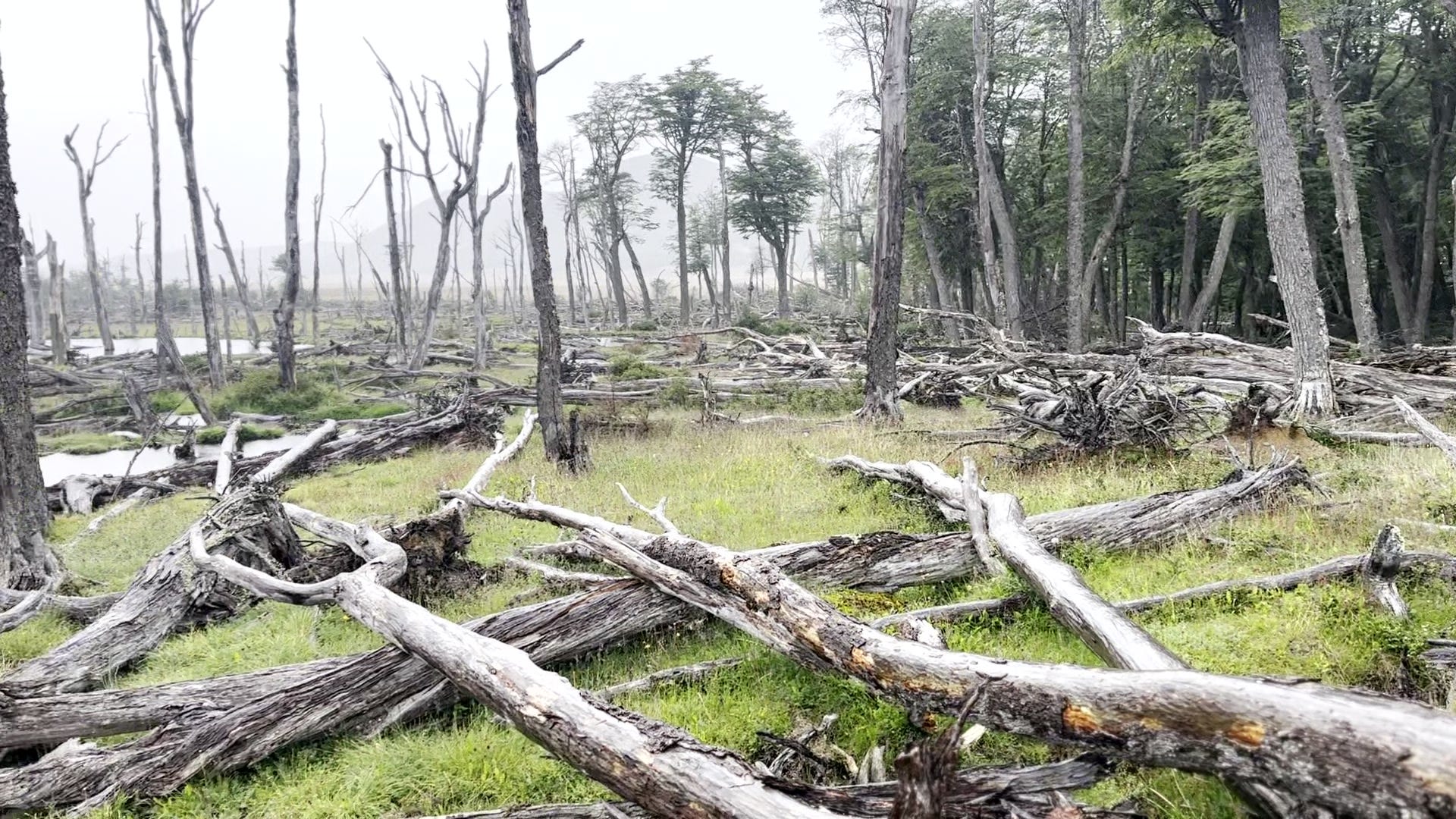
So the forest, when we got there, was a shock. At its edge, Marcos asked us to dismount, his voice quieter than usual. As we tied our horses just outside the grove, the reason became clear. What opened before us was less a forest than a graveyard. A sea of dead trees — standing, for now, but silvered, bare, gnarled — rose all across the field; fallen logs, crisscrossed and grey, latticed the dark water.
“Look closely,” was all Marcos said, and so I tried to see it: The way that some of the trees, though still upright, were ringed at the bottom, the bark scraped through, the inner layer exposed. The way that the fallen trees, stacked haphazardly where they fell, had lost their moorings just above their roots. The way that the water rippled in the wake of a beaver’s glide, before he slapped his tail in annoyance and splashed his way beneath the surface. It was only then that I began to understand. Marcos caught my eye. “You see? The beavers are killing it all.”
And then he told us just enough of the story: that in the 1940s, the Argentine government — eager to capitalize on the global demand for beaver pelts by building a fur-trapping industry in this seemingly vacant place — imported a few dozen North American beaver to the island that is Tierra del Fuego. But the end of the earth proved too remote for the purpose, and the plan was soon abandoned. The beaver, free from natural predators, were let loose to multiply amidst a native tree species that cannot withstand their ceaseless gnawing. The ecological balance tipped in the animals’ favor; throughout this region, the forests are turning to graveyards.
Though I listened intently to the tale Marcos told, I couldn’t take in all that he said. I didn’t know how to weave together the threads of information: that such a destructive force could be so unwittingly introduced — that something so small, set loose with such simple ignorance, could have caused damage at this scale, and that it could so easily be done. Standing at the edge of the tree-clogged water, I struggled to absorb history and ecology and beauty and death all at the same time. My brain couldn’t make sense, and words failed: “It’s a lot” was all I could muster.
We stood together for a while, silent and still — looking. No words, just breath. The horses shifted their weight, their heads lowered as they pulled at the grass. Eventually, with nothing more than a glance, Marcos signaled us all: it was time to go.
On the ride back, we kept a measured pace, speaking in low tones only here and there. When we drew up to the estancia’s simple clapboard stable, our groom, Ivan, stood at the ready to relieve me of my horse. After a long day, I was pretty sure he would welcome a nip from my flask. So, still in my saddle, I gestured it toward him. With a nod and quick grin, he took my reins in one hand, and my whiskey in the other.