

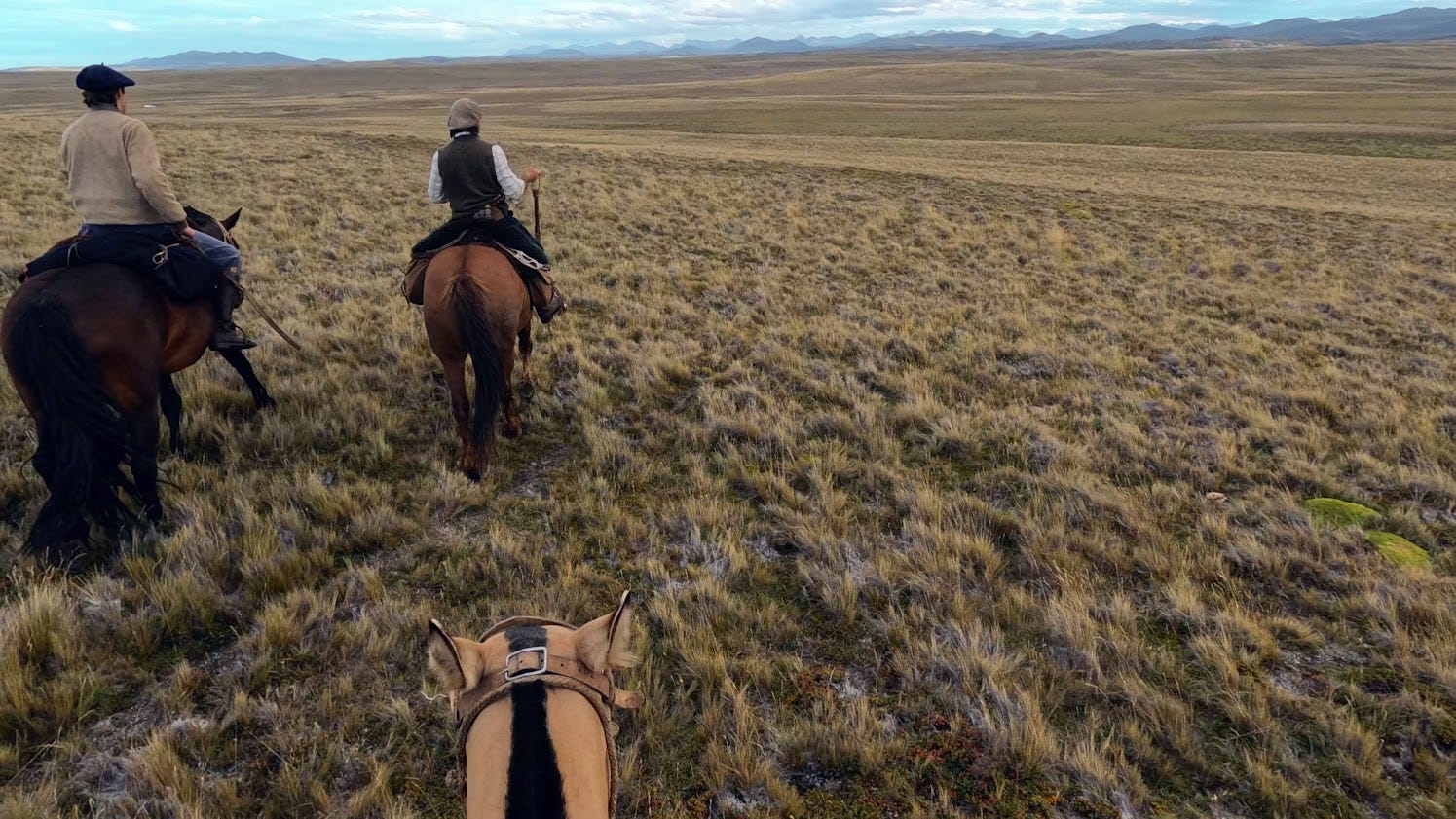
There are days on a ride that are simply about distance. This was one of them. Today, we would leave the estancia far behind, traveling more than fifty kilometers, carrying with us all that we would need.
The ponchos we’d been given — startlingly heavy, dense — had felt, on our first day, more like costume than equipment, and the whiskey-filled travel flask felt more decorative than useful. But by this morning, we retrieved them with the particular appreciation reserved for things handy to have in demanding conditions — things you tend, like embers banked overnight.
All I knew of Ivan was what I saw at each day’s start, as he tacked the horses up, and each day’s end, when we dismounted and he took over. At first glance, the tack he assembled seemed more like layered bedding than the English dressage saddle or Western working saddle I was used to. First came a white sheepskin, placed fleece-side down against the horse’s back. Next he placed a thick woven wool blanket, like a standard Western saddle pad, then a shaped, lightweight leather saddle, equipped with stirrups and a fleece-faced girth. Over the top of that, Ivan laid a second sheepskin — this time, with the fleece facing up, to cushion the rider. To hold it all together, he wrapped a leather strap entirely around the horse’s barrel, cinching it in place.
Then came a halter of plaited rawhide, a geometry of triangulated shapes; to it, he attached a lead rope of rawhide line, its loose end coiled at the rigging. Over that, he placed the bridle; made also of rawhide, it was stripped to the elements essential to managing the bit — just a head piece, browband, and two cheek pieces. Finally, both in front of and behind the saddle, he slung saddle bags of wool and leather, with rawhide ties for bedrolls or ponchos.
What Ivan carefully assembled each morning is known as the recado. More than a saddle, the recado is better understood by its deeper origin: it descends from recaudar, meaning everything gathered and secured — the full supply of what’s needed for a task.
So, well equipped, we rode out, the day settling into a steady rhythm. I didn’t know the landscape we would encounter or where we would end — “to the caravans” was about all I knew of the course we set. But that morning I began to discover a deeper certainty: that whatever we needed, we already had — and that, like an experienced rider ponying a colt, Marcos would take us safely along. That unspoken agreement set me free, it seemed, with nothing to decide, nothing to track, no reason to worry. Just Marcos in the lead, and the country coming on.
At regular moments along the way, when the ground was especially clear, Marcos would turn in the saddle. The horses knew the turn’s meaning before we did. But soon enough, we knew it, too. With a tilt of his head, he would call out what proved to be his characteristic invitation: “Ready for a canter?”
Whether it was our position in the valley or a bit of magic granted to the day, the wind had stilled. We followed the curves of the shallow river, splashing across whenever the path proposed it. The horses bent their necks to drink. Reflecting back in the river’s clear waters, the sky was as blue as ever I’ve seen. On the ridges above, clusters of guanaco looked down at us, laughing.
Only a few hundred people had crossed this hidden valley over the past hundred years, Marcos explained. All day, what I had noticed was the valley’s beauty, and its silence, broken only by the sound of our quiet voices, just four riders and two guides inhabiting an entire landscape.
But what I hadn’t understood was the source of this silence: we rode the path of the Selk’nam, one of the three indigenous peoples of Tierra del Fuego. Long before the sheep and the fences, before the gauchos and the estancias, this steppe was home to the Selk’nam. For more than 10,000 years, the Selk’nam had occupied the open grasslands of the interior steppe, subsisting as forager-hunters, hunting guanaco and the small rodent they called apen, and building temporary shelters using hides and poles. Yet over the course of just a few decades at the end of the 19th century, they were hunted nearly to extinction.
It started with the gold-seekers. Julius Popper, an engineer turned prospector, led armed expeditions that hunted the Selk'nam outright, clearing the land for unimpeded acquisition. But the gold was never as abundant as the reports suggested. When the gold ran thin, estancieros — large-scale sheep ranchers — moved into the region. The Selk’nam, who had hunted guanaco across that grassland for millennia, began to hunt these sheep in turn. The estancieros, treating this as ready justification to eliminate the people wholesale, hired mercenaries in retaliation. José Menéndez, the largest sheep rancher in Patagonia, employed as foreman a Scottish mercenary named Alexander MacLennan, who paid his men for each Selk’nam ear they delivered.
So this quiet valley had never been just empty; over the course of just a few decades, it had been violently cleared and claimed and taken from those who had made it their home for millennia.
During our ride, I knew none of this history. So when we rode up at dusk to a string of gaucho caravans set along the hillside — a miniature village, made ready for us — I was only tired, glad for food and company and a small space to call my own for the night. Ignorant of the story of the land below, I slept.