

It’s a pretty small plane, the one that takes you from Buenos Aires to the far southern tip of South America. And for reasons known only to the invisible algorithms that decide flight routes and frequencies and load, your plane leaves in the middle of the night.
Which means that it’s midnight when you make your way to the airport; in a big city with two airports, this is the little one, located not far outside the city limits but right there, only a mile or so from the Palermo neighborhood. “I could have walked here,” I thought, as I pulled myself from the taxi.
In this puddle-jumper hub, the terminal is easy to navigate; security is quick, baggage check is easy. At 1 AM, the shops are mostly closed, but the place is surprisingly busy. As I settle into a bare-bones seat at the gate’s small waiting area, I start to register the people around me. No business suits here, no click-clack of high heels. Running shoes, hiking boots; gear bags, cases for rods and reels, fleece and all-weather gear; and everybody — everybody — has a backpack. These are people dressed to move.
What I’m looking for, though, is a particular tell: paddock boots, that universal sign of a horseback rider. While it’s true that some rides attract the Western boots crowd, this one — with its long days in and out of the saddle, the varied terrain and the need for the easy on/off of all-weather pants — this one calls for the all-rounder utility of the paddock boot. No rider worth her salt will pack those boots, let alone check them. On a trip where your boots are the irreplaceable essential, it’s safer to keep them on your feet.
So as I wait for the boarding announcement, I play my horse-girl version of Where’s Waldo: I look for the boots, for the people, mostly women, who carry a certain disregard for artifice or decoration — too messy, in the barn, and too easily snagged off — and who move with an easy physicality. I peg one or two in the waiting area before the flight is called.
Once on the little plane, the game continues. As I ear-hustle my way along, I pick up a few more clues, and by the time we land — no air bridge here; we walk down rickety metal steps and across a tarmac to a low-slung building where we all pull bags from the very small carousel and then I’m walking uncertainly in the general direction of the exit, looking for somebody with a van and a sign that says I’ve found the right place — by then, I’ve pegged them and apparently they’ve pegged me. “Come this way; they’re waiting for us over here. You’re riding, right?” And now you’re part of a gaggle, where two more strangers with open smiles and an easy way about them somehow seem to know who you are as they check your name off their list; soon, you find yourself hustled towards a van where someone offers you chocolate and little cups holding something hot, and then you’re trying to notice faces and find a seat and make sure to smile, and you begin to bridge the gap between getting there and being there. And as one of your guides slips behind the wheel, he turns to look over his shoulder with a welcoming nod. “I’m Marcos,” he says, as he pulls from the curb. And it’s then you know for sure: you’re on your way.
At the end of the earth, the wind is something you either confront or accept. You discover this in the first hour — it is not the wind of a storm, which surges and passes, but a constant presence in the sound and shape of this land.
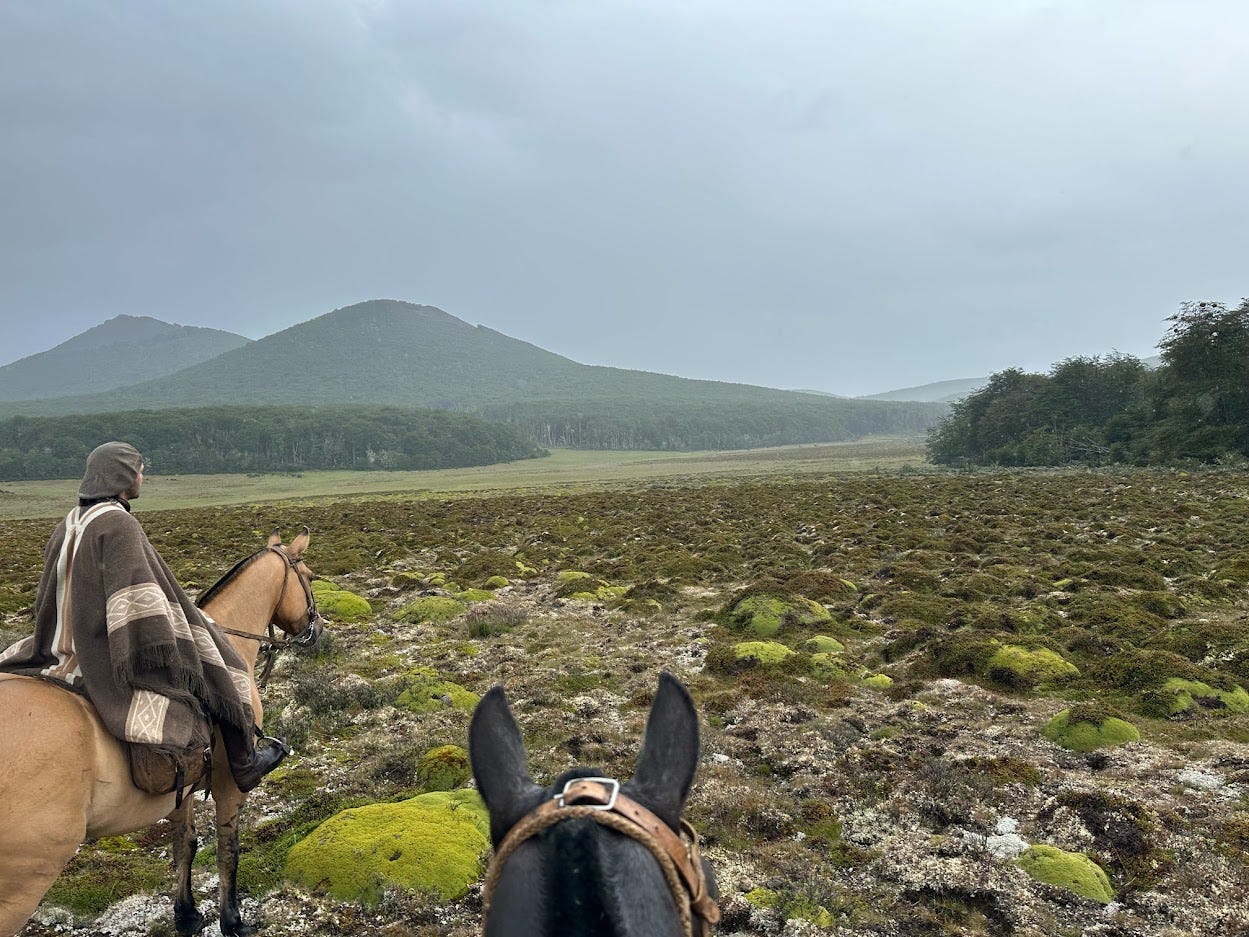
This first day’s ride is short by design — an introduction of horses to riders, riders to landscape, people to one another. As clouds gather and rain begins to spit, the grass grows slick, the terrain a maze of tussock mounds, peat hollows, and hidden marsh. With its slopes and dips, its tangles and divots, this rugged land rewards a steady hand and a balanced seat.
Marcos sets the pace of the gait and the tone for the group: he is amiable and utterly comfortable as both leader and host. Adept with his horse, he makes easy conversation as we move, no doubt silently assessing the riders he guides. Backing him up is seventeen-year-old Jacinto: the latest in his family to take his place on the steppe, he is resplendent in a glorious black cloak whose scarlet lining whips bright in the wind. A gift from his mother, he later confesses.
Neither loamy soil nor hardpacked earth, the tussock is new to me. Bunched into clumps, the deeply rooted grass forms a dense patchwork of isolated mounds, creating an uneven surface that demands careful footfall. My first impulse — to neck-rein my horse across the unfamiliar surface — quickly proves both unnecessary and naïve: true to his Criollo nature, my horse Bayo — like Marcos — moves with insight and ease.
This first ride lasts only a few hours, circling back to the estancia we had first reached only that morning. But by the time we return to the shearing shed, surrendering our ponchos and accepting the whiskey that magically appears, the world has shifted a bit. As we draw up our chairs for dinner around the family table, we’re well past the need for introductions, now.