

In 1845, an English immigrant named Richard Blake Newton embarked on a bit of a home-improvement project, the first of its kind in all of Argentina. He and his Argentine wife, María de los Santos Vázquez y Molina, were raising 15 children on “Santa María,” their sheep-breeding estancia in the Chascomús region of the Pampas, about 75 miles south of Buenos Aires. Driven perhaps by the very real challenges of feeding a family this size, Newton seized on an innovation he had first encountered the year before, when he’d chanced to visit Wentworth Woodhouse, one of England’s grandest country estates.
At 15,000 acres, Wentworth was famed for its menagerie, which held 62 species of birds and 27 species of mammals, among them llamas, kangaroos, and even a brown bear. But what apparently most impressed Newton, amid all this exotic display, was the sight of a herd of deer grazing in the estate’s decorative deer park. Surrounded by sweeping vistas, they were held in not by walls or palisades but by a simple fence of thick iron wire — needing no watchman. Newton, a cabañero de ovinos — a sheep-breeder — saw at once what a barrier that needed no wall and no keeper might be worth to a man with a great deal of land and a great many animals. He took quick action, importing 15,000 yards of wrought-iron wire, plus 500 one-inch iron rods. That the wire arrived at all was something: in 1845 the port lay under foreign blockade, and everything that came by sea came hard and dear. Once equipped, he drew lines around his garden, orchard, and two stands of trees — keeping the fruits and vegetables for his family, and away from the sheep.
With that initial import of wrought-iron wire and rods in 1845, Newton solved a true domestic challenge, at a scale sufficient to protect the kitchen gardens within one family’s estancia. Yet wire was heavy, and estancias encompassed far more than their house and gardens. Protecting a crop by keeping sheep out — as Newton did — was one thing. But reorganizing an entire estancia — so as to keep sheep in and keep cattle out — would be something else again.
It took more than a family man to solve that problem; as it would happen, it took Franz (Francisco) Halbach Schmidt — a merchant and industrialist who carried the lofty title of Consul General of the Kingdom of Prussia in Buenos Aires. By the early 1850s, he had purchased an estancia known as Los Remedios, of perhaps 12,000–15,000 hectares, large enough to manage an estimated 30,000 sheep. With an eye towards the export value of fine-wool merino, Halbach set about importing two specialized breeds — German Negretti and French Rambouillet — to improve his flock.
But a fine flock is a fragile thing on open ground: were his merinos to mix with the criollo sheep — the native, unimproved flocks — drifting across the open country, the bloodlines he had paid for would dissolve within a season. The solution to this problem was not the wire — that was the same finger-thick iron Newton had strung a decade earlier — but the world that had shifted around it: with the end of the foreign blockade, the port had reopened, and the wool that had been a trickle became the country’s great export, leaping from roughly 1,600 tons in 1844 to some 8,500 by 1850. Which meant that Halbach — a man with ample capital, ready access to imported wire, and high demand for exported wool — could now do what a family man in a blockaded port had not.
So Halbach prepared to ring the whole of Los Remedios — four wires deep, a ditch thrown up outside them — and make of the open camp a single enclosed reserve. But fencing an entire estancia would take more than wire. Built post by post, stiff strands drawn tight across mile upon mile of open ground, it would require men working hard with their hands, inching their way across the plain.
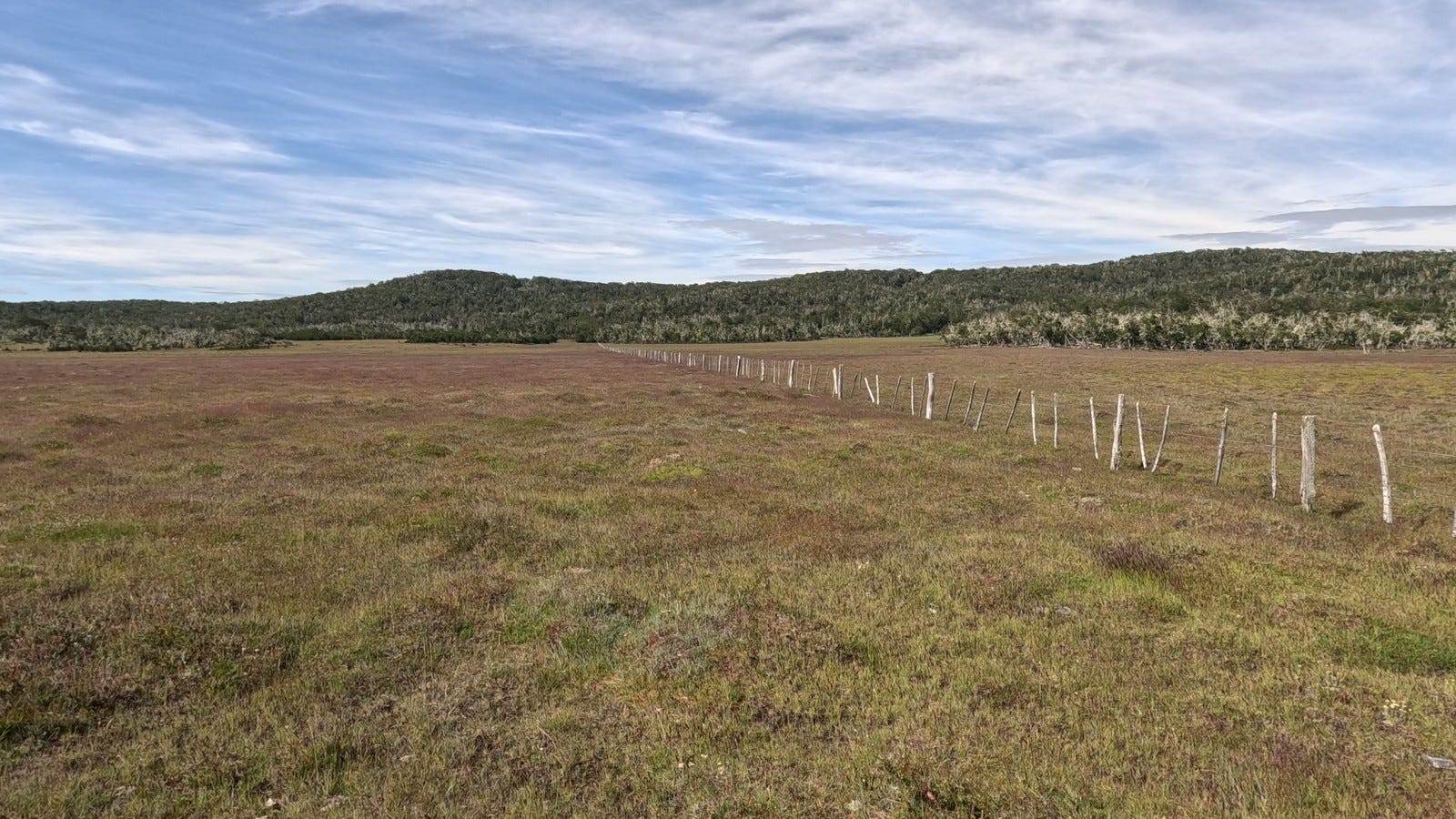
It was a new kind of work, done by a new kind of worker: alambradores, the wire-men. The job fell, almost from the start, to newcomers — Basques first, then others off the immigrant ships.
For stringing wire was not the gaucho’s work: he was a man on horseback, and this was tarea de a pie — a task done on foot. So, post by post, the open country was closed by other men, brought from other places.