

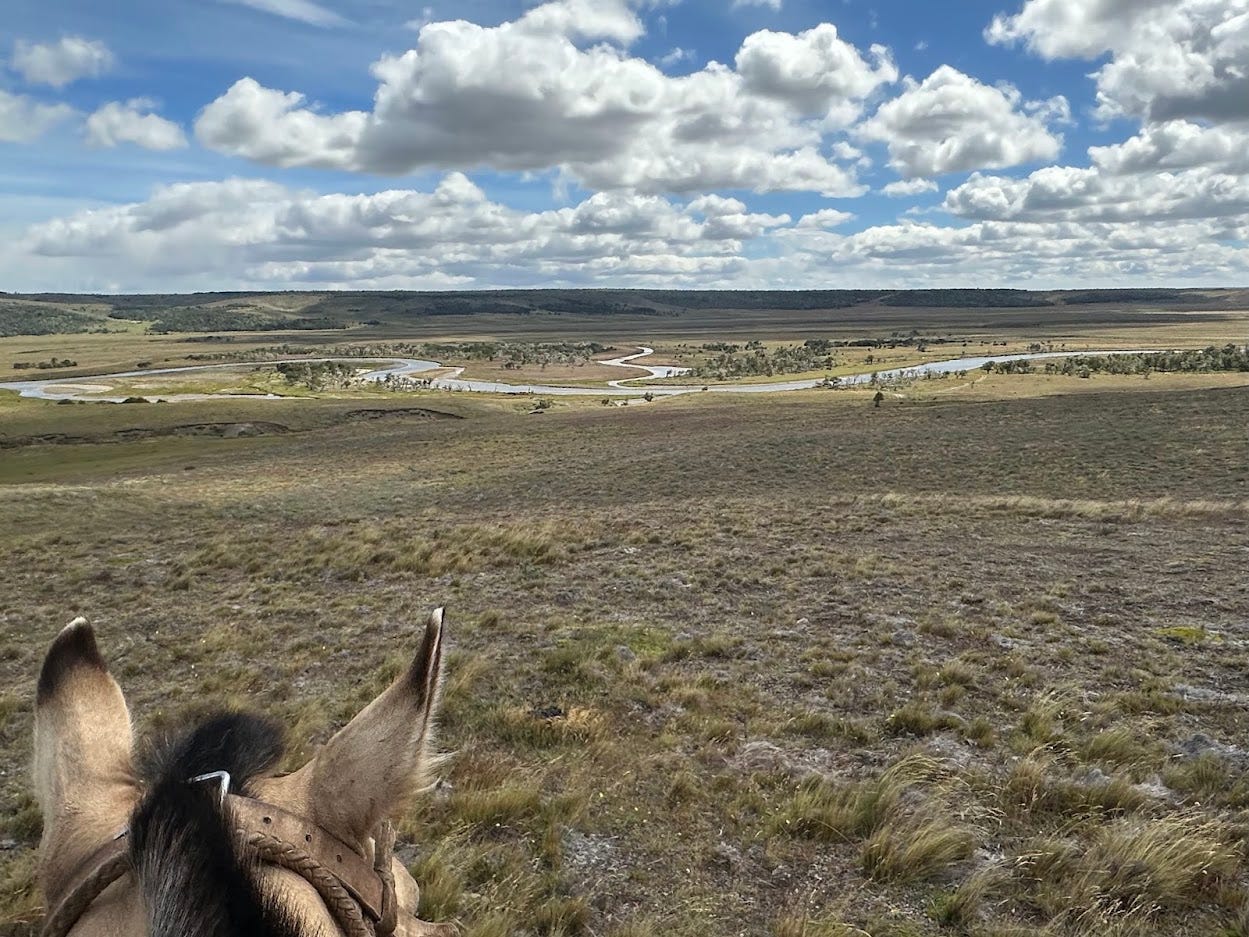
The day starts with the river. You ride out north from the estancia in southern Argentina, the Río Grande somewhere ahead — a fact of the map before it is a fact of the eye, because this is open country and the land holds its water low. The wind is just as it is, clouds scudding fast across the sun.
We reached the water mid-morning and kept its company for hours. Running slow and gentle between marsh-edged banks, this river is famous out of all proportion to its scale: sea-run trout push up it from the Atlantic, and people cross the world to stand here and cast their lines. Pulling lunch from saddlebags, we ate on a grassy bank and then dozed, unhurried, as the horses grazed nearby. The wind did most of the talking.
Later, as the circle of the day’s ride turned us back toward its start and the light began to slant, Marcos guided us alongside a line of low ridges and hollows in the grass, their edges long since softened — the kind of thing you might take for an old water-work, riding past without a thought. An ordinary scar in the life of a landscape.
But rather than evidence of everyday infrastructure, we learned, these hollows were remnants of military trenches built for a war that almost started, for control of three islands that few can name, and at a price that many have paid.
At heart was a familiar tussle between two nations arguing over a border. In 1881, when the Boundary Treaty established the Beagle Channel as the dividing line between Argentina and Chile, it failed to chart the path the channel took — and so, though its terms gave Chile every island south of the channel, no one could say which islands those were. In practice, the doubt came down to three small islands at the channel’s eastern mouth. For the better part of a century, the two sides squabbled over them, but the stakes stayed small: the three meant kelp, guano, and a lighthouse.
What changed was what nations could do with water. Technologies developed for World War II found new purpose around the world. Sonar built for hunting submarines became fish-finding; and refrigerated factory trawlers carried the far side of the planet’s catch home. Since the 1940s, Argentina had drawn oil from beneath this island to heat a nation of homes that had long relied on wood and coal — and now the derricks were learning to drill the seabed itself. The new law of the sea hurried after the technology, drawing two hundred miles of ownership around every shore: whoever held a rock when the rules locked would hold the water around it forever. So when the two countries carried the question, as they had done before, to arbitration under the British Crown, and the award went to Chile, Argentina’s military dictator refused it — and called up the fleet.
A country at war takes what it can reach, and what Chile could reach was here, this bit of the island. The border between the two nations crosses Tierra del Fuego itself, north to south, just west of this grass. On the Argentine side of it sat Río Grande — the naval air station whose planes would cover the fleet and the landing force at the islands. Knock it out, and the operation to the south would lose its air umbrella. A war between neighbors over three small islands does not end in conquest; it ends at a table, where each side trades what it holds. If Argentina seized the islands, Chile’s strongest counter was not to wrestle over the three small rocks — it was to take the Argentine north of this island: the base, the town, and the oil country — the whole island, then, and the chip to trade against the rocks.
The conscripts were boys: twenty years old, all of them born in 1958 — in the conscription rolls, the clase 1958. Two years earlier, at the door of their service, the army had taken away their identity papers — and without papers, a man could be held for as long as he was needed. Their two years were nearly up; they should have gone home that October. Instead they were held, and sent here, to dig these trenches into the grass between the border and the base. Across the whole frontier that December, three hundred thousand men were mobilized — the largest call-up Argentina made in the twentieth century.
Argentine marines prepared to land on and occupy the three islands at dawn on December 22. But in a place where the weather bows to no man, a storm blew in and pushed the planned invasion aside. In this heavily Catholic land, a messenger sent by the Pope, Cardinal Antonio Samoré, reached Buenos Aires before the plans could be reset. The mediation he began would take six years, and would end just as the arbitration had: the islands went to Chile — agreed to, this time, by a democracy, in a vote where four of every five Argentines chose peace.
When the war failed to arrive on schedule, the conscripts were not sent home; instead, they were held at the border for months, well into the following winter. But after eventually discharging them from duty, Argentina declined to recognize them as military veterans — there had been no war, after all. Decades later, a congressional bill would refer to this as “a situation that no one gave account of.” Even today, men well past their years of military service are asking their country to acknowledge a history it declines to tell. Only later, studying a map at my desk, would I realize where we’d ridden that day: this history was just a stone’s throw away, and we’d traced the border’s invisible path.
We rode the last hour mostly in quiet and came back to the estancia at the blue end of the light. Here, there was fire, and dinner, and the easy noise of people glad to be gathered inside — the long table full, every one of us accounted for. In the morning, we would leave this place and, together, ride south.