

In 1925, a Swiss-born Argentine schoolteacher named Aimé Tschiffely set out from Buenos Aires on two Criollo horses — Mancha, a skewbald, and Gato, a buckskin, both reportedly fifteen or sixteen years old — with the intention of riding to New York. Most horsemen of the day considered the plan lunatic: the horses too old, the distances too great, the terrain too various. Sixteen thousand kilometers later, after crossing the Andes twice, traversing the jungles and deserts of Central America, and arriving in Washington in 1928 — just short of his original goal of New York — Tschiffely had demonstrated something no breeding program could manufacture: the Criollo’s capacity for sustained effort in arduous conditions. They were wildly celebrated, even if the breathless reports overstated the claim a bit: Tschiffely depended on boats to bypass parts of the perilous Panamanian jungle, and on a train to ship Gato through Mexico after he went lame. But the accomplishment was clear, nonetheless.
Mancha and Gato belonged to a breed barely three centuries old, but the history of the horse is far older and it passes over the same ground Tschiffely set out to cross. The horse evolved in the Americas roughly four million years ago, spread across the Bering land bridge into Asia and Europe, and then vanished from the Americas entirely at the end of the last Ice Age — for reasons still debated — some mix of climate change and, perhaps, hunting pressure from newly arrived humans. When the Spanish reintroduced the horse in the sixteenth century, they unknowingly returned something ancient to its native place.
The first horses reached the Río de la Plata with Pedro de Mendoza, who founded Buenos Aires in 1536. When the colony collapsed under Indigenous resistance a few years later and the Spaniards fled, a dozen or so horses were left behind. By the time the city was resettled in 1580, the Pampas held feral herds in the thousands. The stock was Iberian — predominantly Andalusian and Barb-derived, compact and hardy — and it was the landscape, more than any human intention, that bred them for hardiness. The open grasslands offered abundant native forage but no shelter or supplemental feed in the harsh seasonal extremes, while the uneven, tussock-broken terrain rewarded sure-footedness and strong hooves. Rather than the most refined or the fastest, the horses that survived were the most efficient, with the capacity to extract maximum energy from minimum forage, to cover enormous distances without metabolic collapse, to regulate body temperature across a wide range, and to read and navigate uneven ground without injury.
It was the Pampas itself that made horses tough enough to carry Tschiffely.
Further south, the archipelago of Tierra del Fuego remained horseless for a time; the dense forests and the geography of the Strait of Magellan prevented natural migration to the main island. It was only in the 1880s that horses arrived there, brought by fortune seekers during the Patagonian gold rush and by European estancieros, who could not hold a range that size without men in the saddle.
By the time of Tschiffely’s ride, the horse had become known as the Criollo, a name that reflected the history of colonial enslavement. It was derived from the word crioulo, meaning a person raised in a colony, not transported to it, which itself derived from the Portuguese verb criar: to breed, to raise. A word first used for enslaved Africans born in the Americas, it was then extended to encompass everything native-born in the colonial world, and then to name this horse.
By Tschiffely’s day, the Criollo was the subject of a fight over its definition. A century of crossing with imported Thoroughbred, coach, and draft stallions had nearly bred the old Pampas horse out of existence. Beginning in 1918, a veterinarian named Emilio Solanet set out to recover the Criollo, buying up purebred stock — including horses held by an Indigenous group in Chubut — to found a studbook; the breeders’ association formed in 1923, and the compact breed standard was not settled until 1934. It was Solanet who provided Mancha and Gato. The ride was a demonstration for his cause — proof that the purebred Criollo was worth preserving.
The recovery did more than preserve a type. Within a generation, the Criollo had become a national symbol — its endurance proven in the Sociedad Rural’s long-distance trials, the breed that fashion had nearly destroyed now claimed as something particularly Argentine.
The point that Tschiffely made when he rode into North America is that Mancha and Gato were not exceptional specimens; they were ordinary representatives of a powerful breed the estancia economy had required — animals whose capacity for sustained effort over distance was not a remarkable achievement but a baseline characteristic. His ride was not a demonstration of what a specially prepared horse could do; instead, it demonstrated what the Pampas had been producing, unaided, for three hundred years.
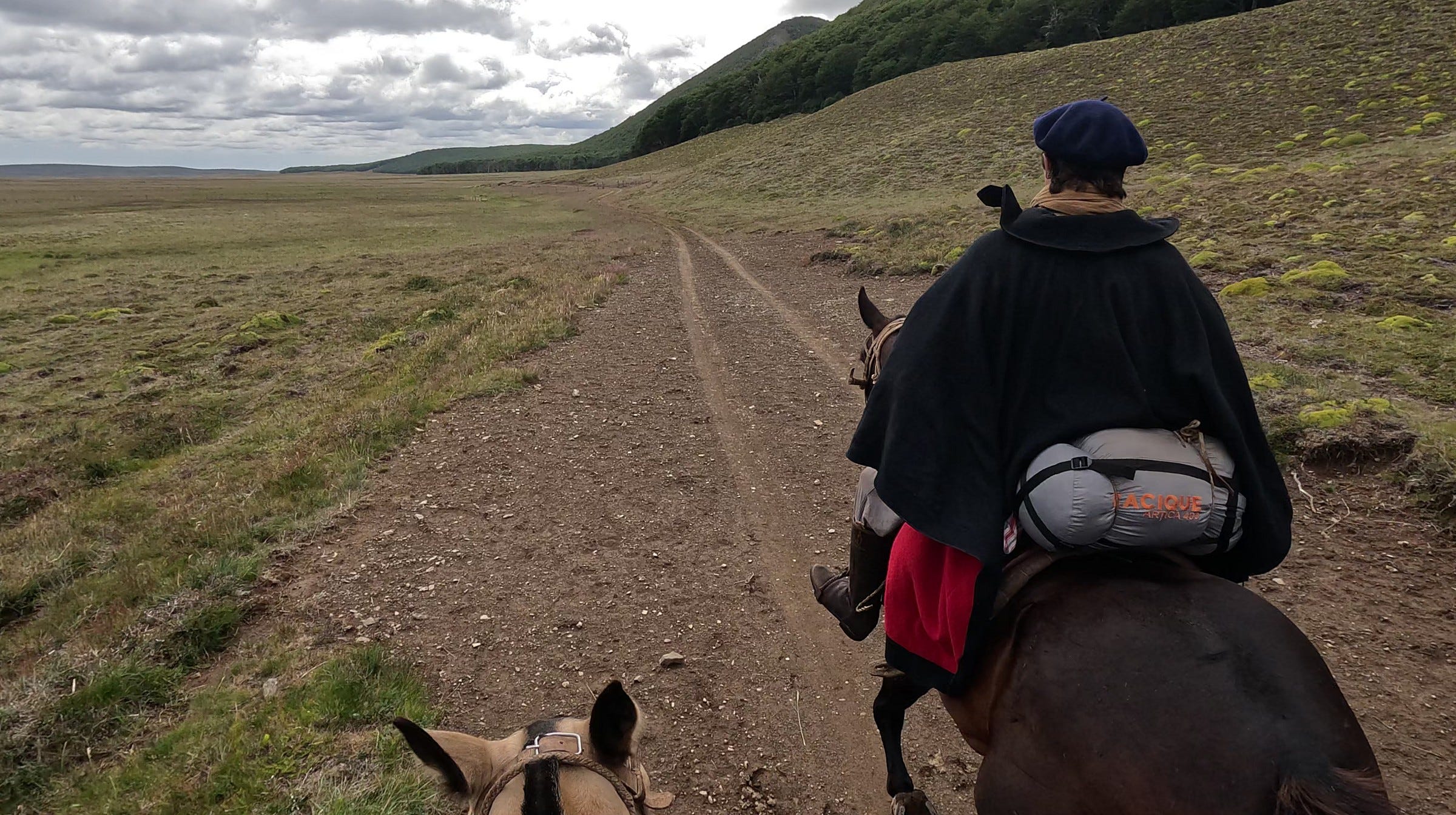
This essay is Part Three of the Tierra del Fuego Ride Companion — eight days on horseback from Río Grande into the Fuegian Andes, with the history of the ground, its people, and the horse that carries you across it. Read the full guide, or subscribe to A Good Seat and get it now, along with every guide that follows.